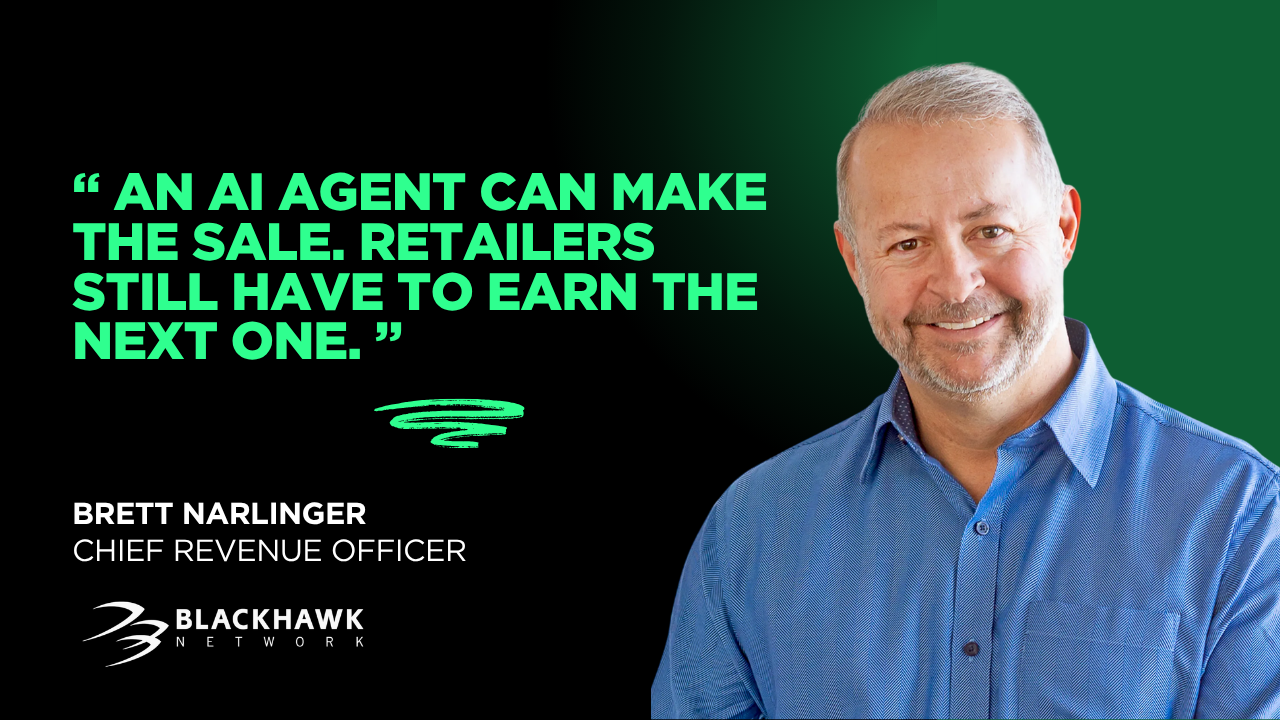
By Brett Narlinger, Chief Revenue Officer, Blackhawk Network (BHN)
An AI shopping assistant can find a birthday gift in seconds—a task that once required multiple visits to retailer websites. It can compare products, prices, reviews, delivery windows and purchase policies before recommending the option that best fits the request. As AI shopping agents become more capable of completing transactions, retailers may compete for sales without customers ever browsing their digital storefronts.
That changes how customers discover brands—and what the first transaction represents. An AI recommendation may reflect price, availability or convenience as much as brand affinity, leaving retailers with fewer opportunities to shape preference before the order is placed. The moments before and after the recommendation therefore become more important: retailers must make products easy for AI to understand and the post-purchase experience worth returning for.
Advertisement
300 × 250
AI can only recommend what it understands
AI-assisted shopping is already becoming part of everyday buying behavior. Blackhawk Network (BHN) research found that one-third of U.S. consumers use AI for gift shopping activities such as comparing products and finding the best prices.
That makes product information more important than many retailers may realize. An AI agent doesn’t walk a sales floor, interpret merchandising or infer product details. It works with the information retailers make available.
BHN’s 2026 Best Direct Digital Gift Cards Benchmark Report, developed with NAPCO Research, reflects how much room there is for improvement. Among the 120 brands assessed, 61% earned points for engaging with AI search, but only 5% earned points for AI gifting recommendations. The difference suggests that many retailers already offer products an AI shopping agent could recommend, but not enough information for it to do so confidently.
Gift cards illustrate the point well because they are often described too narrowly. A customer, or an AI agent acting on the customer’s behalf, needs more than confirmation that a digital gift card exists, for example. Available denominations, delivery methods, scheduling options, personalization features and redemption details all help determine whether that product fits a particular need.
The same applies to how products are described. Customers often begin with a need rather than a brand name. They ask for a birthday gift under $50, a thank-you gift that can be delivered today or something appropriate for a teacher. Retailers that describe products through those real-world use cases make it easier for AI to connect an offer to the customer’s request.
None of this requires retailers to rewrite their content in the language of AI. It requires them to remove ambiguity. The brands that are easiest for AI to understand will also be the easiest for AI to recommend.
The next shopping trip begins before the search
Making the shortlist is only part of the challenge. Retailers also need to consider what happens the next time the customer shops.
AI makes comparison shopping remarkably efficient. Price, assortment, shipping and reviews can all be evaluated almost instantly. Those factors remain important, but they become easier for competitors to match every time a customer starts over with a new search.
Unlike most need-driven AI searches, a gift card balance gives customers a reason to begin with the retailer instead of a comparison search. A shopper who already has a balance with a retailer approaches the next purchase differently than someone starting from scratch. That balance becomes part of the decision before products are compared or recommendations are generated. Instead of asking where to shop, the customer is more likely to ask what to buy from a retailer where value already exists.
This has implications beyond traditional gifting. Consumers also use gift cards for self-use, budgeting and managing discretionary spending. Research has shown that shoppers are treating stored value as a financial tool as much as a gift, particularly as they look for ways to control spending and avoid unnecessary debt.
As AI takes on a larger role in purchasing, that behavior may become even more relevant. A gift card allows customers to define where money can be spent and how much can be spent without giving an AI agent unrestricted access to another payment method. For retailers, it also creates another reason for customers to begin their next shopping journey with their brand instead of somewhere else.
That advantage depends on execution. Customers should be able to locate balances easily, understand how they can be redeemed and apply stored value without unnecessary friction. If using a gift card feels complicated, it is unlikely to influence future purchasing decisions.
Loyalty carries more weight after checkout
The first transaction has never been the finish line, but AI may reduce the amount of relationship-building that happens before it.
When discovery is compressed into a recommendation, the customer’s most memorable interaction with a retailer may be fulfillment rather than merchandising. Orders that arrive when promised, returns that are straightforward, customer service that resolves issues quickly and loyalty programs that deliver recognizable value all become more influential because they shape the customer’s first substantive experience with the brand.
Those responsibilities are familiar to every retailer. What changes is their relative importance. Marketing and merchandising remain essential, but they may have fewer opportunities to establish preference before the purchase. The post-purchase experience carries more responsibility for creating the confidence that leads to another transaction.
That also calls for a broader definition of success. Conversion rates remain important because they show whether an offer met the customer’s immediate needs. Repeat purchases, loyalty participation and continued use of stored value provide a stronger indication that the retailer earned more than a single transaction.
AI will continue changing how customers discover products and evaluate retailers. It is unlikely to change what ultimately builds loyalty. Customers still remember whether a retailer delivered on its promise, respected their time and gave them a reason to return.
An AI agent may secure the first order. Earning the second remains the retailer’s job.