1. Many financial institutions are stuck in AI pilots. What separates those that successfully scale AI from those that don’t?
Most financial institutions aren’t stuck because the technology doesn’t work. MIT research found up to 95% of generative AI pilots fail to produce a measurable return, not because the models fail, but because of weak integration, unclear ownership, and change management that never happened. That number tracks with what we see inside banks, lenders, and credit unions specifically.
The ones that scale do three things differently. First, they pick a single simple process with a genuinely repeatable pattern (reconciliation, contract or loan-document review, KYC intake) something with clear inputs and clear success criteria, instead of trying to reinvent “the bank” all at once. Second, they name a business owner. Not a task force, an actual person accountable for the outcome, the same way you’d never run a core-system migration without someone signing their name to it. Third, they treat the pilot’s first ninety days as a staged proof point, not a finish line. They define one measurable goal going in and design toward that number instead of waiting on a big-bang rollout.
Advertisement
300 × 250
The institutions still stuck in pilot purgatory usually have the opposite, a dozen small experiments running in parallel, no one accountable for turning any one of them into infrastructure, and success measured by “people are using it” rather than a number a CFO would recognize.
2. What financial processes should institutions rethink before simply using AI to automate them?
Simplify before you automate, otherwise you’re just making a broken process run faster. Start with a clean sheet: what would this actually look like if the legacy core system, the workaround spreadsheet, and the three approval emails didn’t exist?
Month-end close is a great example. A lot of the manual work in close (stitching subledger data together, chasing reconciling items, rebuilding the same variance report every month) exists because the systems involved were never built to talk to each other, not because that’s the right way to close the books. Automate that exact sequence of steps and you’ve built a faster version of a process nobody would design from scratch.
The same logic applies to loan origination and underwriting workflows, KYC and AML document intake, and vendor or loan-contract review. All processes that accumulated workarounds over years of system change and M&A, where the actual decision logic is much simpler than the process that surrounds it. Before automating any of them, map every manual step with the person doing the job and ask which ones only exist because there was no better option at the time. Do that with real objectivity and, often, half the process disappears before you’ve written a prompt.
3. Where can AI create the most meaningful operational improvements in financial services today?
The most repeatable results are in processes with clear parameters and a clear right answer: reconciliation, contract intelligence, and document-heavy compliance work like KYC and AML review. We’ve done this directly with financial-aid reconciliation in higher ed, which is structurally the same problem as bank or intercompany reconciliation – large volumes, defined rules, a correct answer that today gets buried in manual matching. Those use cases are repeatable because the tool knows exactly what it’s solving for. Same with contract intelligence. It takes a great deal of manual work to collect all the critical contract renewal information and then the renewal often happens without anyone questioning whether it should. We have created contract intelligence systems that alert users to re-evaluate contracts well before the renewal date happens, keep track of the dollars at risk, identify usage levels and opportunities for savings and review external benchmarks for better pricing.
Real-time signals including fraud and transaction monitoring, exception flagging, customer notifications, reaching out to a prospect while they are engaging are the next tier. These signals are genuinely valuable but more dependent on how clean the underlying data is.
Demand and cash-flow forecasting, and credit risk modeling, sit at the harder end. More data sets, more variables, and far more variation from one institution’s book of business to the next, so the AI is doing real analytical lifting rather than pattern-matching a known answer. Institutions get the fastest wins by starting on the first tier, proving the pattern, and using that credibility to fund the harder, higher-variance work.
4. As AI generates more financial insights, how should institutions balance automation with human judgment?
Human-in-the-loop should be built in as part of the design process. AI proposes, a human decides. AI drafts, a human approves. AI flags, a human acts. That’s not a limitation on AI’s value in financial services, it’s what lets you deploy it faster and with more confidence, because you catch the mistake before it reaches a customer or a regulator instead of after. AI is a teammate that drafts material for a human to review allowing you to move faster because manual work is being automated.
This matters more in financial services than almost anywhere else, because the cost of a wrong automated decision like a bad credit call or a missed AML flag is asymmetric. A false negative and a false positive are not equally expensive, and no model I’ve seen fully internalizes that the way an experienced credit officer or controller does instinctively.
AI should be fit for purpose, not a replacement for the judgment that took years to build. The institutions getting this right treat AI output the way a good manager treats a junior analyst’s first draft: useful, often right, always reviewed before it goes anywhere near a decision that matters.
5. How will AI change the roles of financial analysts and operations teams, and which skills will become more valuable?
A lot of talented financial talent has been gruntified, stitching data from five systems into one report, rebuilding the same reconciliation every Monday, copy-pasting between a GL and a planning tool that should already talk to each other. Nobody went into finance to do that. AI takes that slice of the job, not the whole job, and what’s left is the part that was always the actual value: judgment about what a variance means, whether a forecast assumption still holds, how to structure a deal, when a flagged transaction is actually a problem.
The skill that matters most going forward isn’t a technical AI skill, it’s learning to direct AI well, knowing what to ask for, how to sanity-check what comes back, and when to override it. That’s becoming as core to finance roles as spreadsheet fluency was a generation ago.
Mid-career analysts and controllers are actually best positioned here, not most at risk. They already know what a good outcome looks like and AI just helps them get there faster and cover more ground. That combination, institutional judgment plus AI fluency, is a stronger position than either tenure or raw AI skill on its own.
6. For mid-market financial institutions, where should leaders focus their AI investments to achieve measurable results?
Middle-market institutions like community and regional banks, credit unions, and specialty lenders have a real advantage here that’s easy to underrate, less bureaucracy and less technical debt than the money-center banks, which means they can move faster if they use it. The instinct to copy the enterprise playbook, a multi-year platform overhaul with a steering committee, is exactly the wrong instinct. That’s not a middle-market institution’s advantage, it’s the thing slowing down their bigger competitors.
Focus investment on one process with a clearly repeatable pattern and an owner who can be held accountable, rather than a broad AI transformation initiative with no single measurable outcome. Set one goal, whether that’s cycle time, cost per transaction processed, or error rate, with a realistic timeline attached. You should see some signal by the ninety-day mark; the more complex the integration, the longer that stretches, so stage the project instead of waiting on one big-bang result.
Done well, this lets a leaner institution outmaneuver competitors ten times its size, because a smaller org chart means fewer people deciding what to do and how, not fewer capabilities.
7. You believe AI should “elevate talented people” rather than simply replace them. What does that look like in financial services?
It starts with taking away the work nobody in finance signed up for. Nobody became a controller to manually reconcile the same accounts every month. Nobody became an underwriter to chase down missing documents. Nobody became a credit analyst to rebuild the same spreadsheet from five source systems. When AI is designed with a human in the loop, it takes that category of work first, and the humans get back to the work where they can make a difference: the credit judgment, the client relationship, the deal structure, the risk call that requires context a model doesn’t have.
In practice, elevating people also means being honest that not every role changes the same way. Some genuinely get smaller, and pretending otherwise costs you credibility with the people affected. Institutions that handle that honestly, with real retraining paths and clear timelines, earn far more trust than the ones that dress up a headcount reduction as augmentation.
And the person who should lead the rollout usually isn’t the CTO. It’s the top-performing analyst or ops lead who’s genuinely excited about it and respected by their peers. A peer champion earns more trust in a finance organization than a top-down mandate ever will, because their colleagues have watched them get the numbers right for years.
8. What will separate financial institutions that truly transform with AI from those that simply accumulate more AI tools?
Tool count is close to a meaningless metric. Up to 85% of AI deployments fail, and it’s rarely the technology, it’s the parts that never got built: permissions and governance, a real change-management plan, and a path from a working prototype to something embedded in the actual tech stack.
A working demo is the ten percent of the iceberg above the waterline. It looks impressive in a steering-committee meeting, but the real work happens beneath the surface, and that’s exactly the work institutions skip when they mistake a Level One prototype for a Level Three production system.
The institutions that transform treat AI as a leadership problem before a technology problem. They name an AI owner the way they’d name an owner for any material risk. They start with two or three high-impact wins instead of twenty small experiments, because a handful of provable results builds the internal belief that carries the next wave of adoption. And they never let a spreadsheet workaround masquerade as infrastructure just because it’s been patched together long enough to feel permanent.
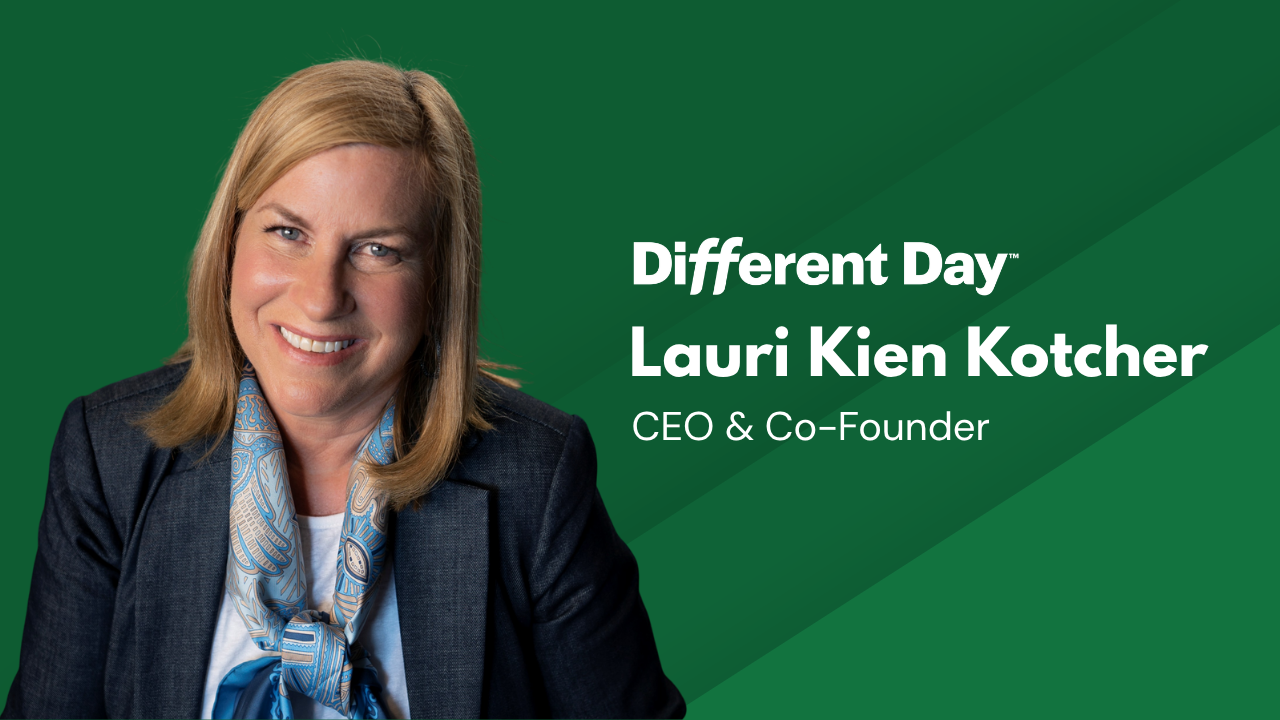
About Lauri Kien Kotcher, CEO & Co-Founder, Different Day
Lauri brings a singular set of career experiences to her role as CEO of Different Day, rendering her uniquely positioned to lead an AI solutions company focused on enabling rapid and scalable transformation to the middle-market. Soon after earning a JD and MBA at Stanford, Lauri joined McKinsey and became a partner with domain expertise in retail and consumer products. After more than a decade she left McKinsey for CMO roles at the consumer health business at Pfizer and Godiva.
Lauri’s CMO tenure was marked by great success at bringing innovation and share gains to legendary American brands. Her next step was entrepreneurial life, becoming CEO at hello products, which was acquired by Colgate for 7x revenue. From there she moved on to the Shade Store, where she brought technological innovation to this leader in home decor.
Finally, before co-founding Different Day, Lauri was CEO at quip, which earned TIME’s Best Invention of 2025. Lauri is a Board member at FreshPet, has served as a Senior Advisor to L Catteron, is an active angel investor with a focus on female-founded business, and is known and loved as a mentor and coach to women in all aspects of business