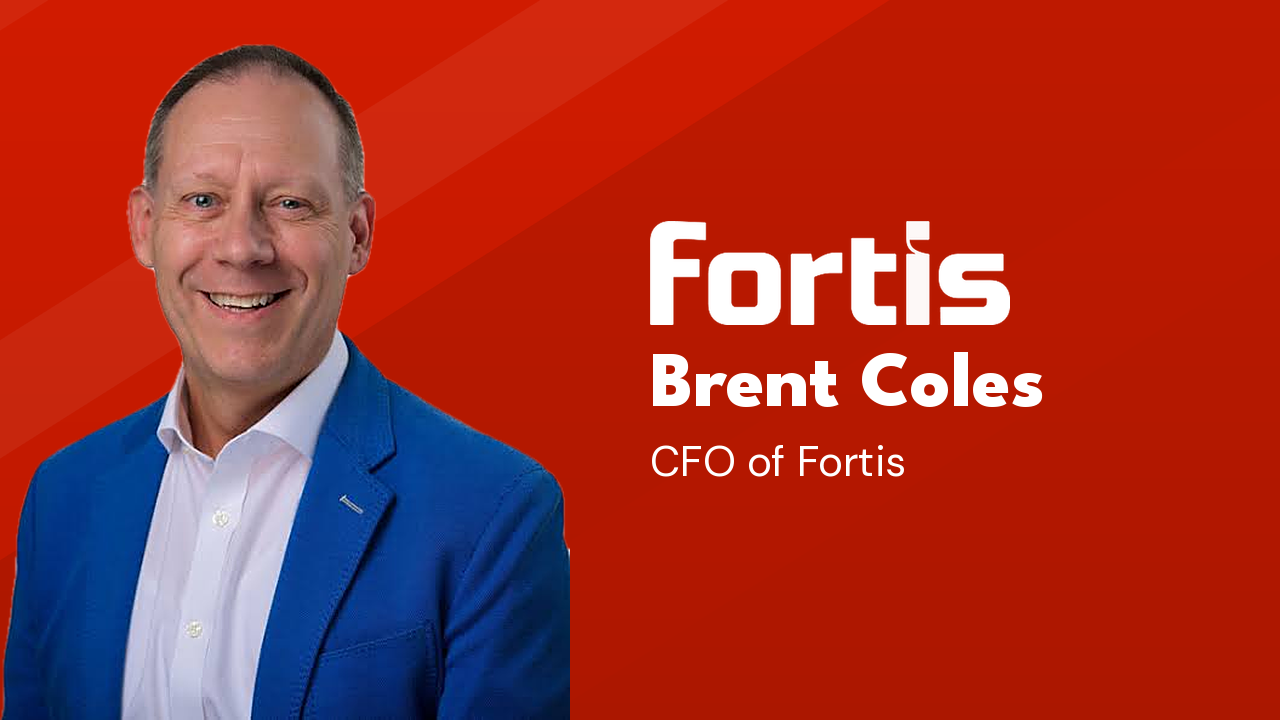
Brent Coles is CFO of Fortis, a payments company. FinTech Edition sent Fortis five questions about its research on payments modernization and cash flow, and he answered them in writing.
How did Fortis select the 100 senior finance leaders it surveyed, and which sectors did they come from?
CoreData sourced 100 senior finance professionals (64% CFOs or finance directors) at SME companies in the U.S. and Canada during Q3 2026. Sectors represented include field services and professional services (33%), construction (21%), wholesale and distribution (18%), manufacturing (16%), and agriculture (12%).
Advertisement

72% say modernizing payments would help cash flow, yet 21% have effective infrastructure. What separates that 21% from the rest?
The top 21% of finance teams, referred to in the study as Maturity Leaders, build a fully connected ecosystem where ERP, AR, and payment data run in one seamless flow. Rather than stopping at basic invoicing, they resolve downstream operational friction, allowing 59% of leaders to reach invoice accuracy rates of 96% or higher while shaving 10 days off their Days Sales Outstanding (DSO). They also monetize payments data for credit risk assessment and customer segmentation. This end-to-end connectivity elevates finance from a back-office scorekeeper into a strategic growth partner.
To be sure, system integration does not occur in isolation. Organizations investing in connected payment architecture typically display broader operational discipline, establishing clean underlying data and standardized workflows before scaling advanced tools.
75% cite integrating automation with existing tools as a barrier. Which integration is hardest, and how does Fortis handle it?
Reconciliation and cash application represent the single hardest integration hurdle because, unlike invoicing, they depend on external data across cards, ACH, wires and paper checks. Fragmented data and remittance discrepancies cause payments to stall across siloed departments. Fortis resolves this by embedding payment capabilities directly into the ERP environment. By uniting invoice creation, digital payment links and ledger posting within a single workflow, payments post on the day they arrive without manual rekeying or reconciliation backlogs.
The report links connected financial systems to lower average DSO. By how many days, and what drives the gap?
Maturity Leaders achieve an average DSO of 10 days lower than non-integrated peers. For a $50 million revenue enterprise, this 10-day acceleration unlocks roughly $1.37 million in free working capital.
While late customer payments play a role, the gap is primarily driven by internal operational friction across the four clocks of DSO: issuance, delivery, payment and cash posting. As one construction CFO noted, a major contributor to high DSO was simply knowing whether an invoice had been sent. Maturity Leaders eliminate this lag by enforcing centralized ERP invoicing, providing real-time visibility from issuance to final posting.
What did Avalara and Traild contribute to the research, and what did each add?
Avalara and Traild co-commissioned the research alongside Fortis to provide a holistic view of the finance operating model. Raymond Yue, senior vice president of finance at Avalara, and Adam Leski, chief growth officer at Traild, provided insights into a variety of topics such as AI readiness and the automation lifecycle from different perspectives.
Source: Fortis research release, written answers from Brent Coles, CFO of Fortis.