We have automated so much of daily life that it is easy to accept a world with fewer basic human interactions. Alexa knows your grocery list. Waymo gives you a ride. Siri reminds you to pick up a birthday gift. People lean into faceless help when the stakes are low.
Banking sits in a different category. When the conversation turns to money, payroll, savings, and business accounts, people still want a person. They do not want their financial life treated like another smart home task.
Banks are bolting AI onto their story, branding call centers as “virtual agents” and front doors as “AI‑powered experiences.” Yet many customers feel a different reality. They are met with error‑prone bots, dead‑end chats and a nagging sense that their finances are being left to systems no one is really accountable for. That disconnect erodes trust built over years.
Advertisement

This industry has always played by different rules because the stakes are higher when people and businesses put their livelihoods in someone else’s hands. Banking today is often measured in headcount and response times, but we cannot overlook what people expect from their bank when something goes wrong.
AI conversation at banks leans heavily toward efficiency. Most executive teams and boards ask how many calls can be deflected, which processes can be automated, and how much cost can be reduced. Those questions matter on a budget line, but they don’t account for the question customers ask in a crisis: who can fix, and how quickly?
Consider a small manufacturer submitting its regular Friday payroll file. By mid‑morning, employees are texting about missing deposits. An automated control misreads a routine change in routing numbers and holds the file. For the system, it is just another exception. For the workers, it is rent and grocery money that did not arrive.
That situation is resolved by the payments and compliance teams who understand the rule set and the business. Someone must see that the pattern is not fraudulent, explain what happened, override the block, and get the file released the same day. The controls stay in place, and the company keeps its employees’ trust.
Now take a small retailer whose operating account is frozen after one flagged card transaction. The model correctly stops questionable activity, but freezing the entire account can put any business on life support within hours. In that moment, there is a clear difference between a generic “we will look into it” message and a banker who picks up the phone, works the case with fraud and operations and gets the account unlocked.
Bank M&A season is well underway. Deals are moving at a pace the industry has not seen in decades, reminiscent of the pre‑COVID era. Banks with at least $5 billion in assets now hold roughly 90% of all U.S. bank assets. When a familiar community brand is folded into a bigger bank, customers see new logos, new apps and more automation before they ever meet a new banker.
If a system goes down during that shift, whether it is a payments outage, a glitch in the online portal or delayed deposits, those same customers are suddenly dealing with a bigger, less personal organization right when they need a clear answer. Relationships once built on human judgment are tested by a more distant experience when things go wrong.
Bank leaders feel this gap every day. We are still a long way from handing the bank over to agents and letting them own customer conversations. Customers are seeing too many errors and odd responses, and they are understandably hesitant to turn a substantive portion of their business or financial security over to a system that does not consistently deliver.
There are real applications and savings in areas like development, testing, and internal efficiency, but no one wants a faceless bank. When money is on the line, people want to know who they are dealing with and who is accountable.
Community banks should see this as an opening. Large brands that have spent years promising frictionless digital journeys are course correcting with massive ad spend reassuring people they can still talk to a person. That tension exists because customers are running into the limits of automated decision making.
AI is faceless. Community banking is about seeing the faces you trust. AI doesn’t care about its reputation in a community; it would advise against sponsoring a little league team or buying a 4-H calf because of insufficient ROI. AI would be inflexible when a customer hits a rough patch. Human judgment and accountability still matter in ways technology cannot quite match.
AI models are improving, but they are not ready to own every anomaly or nuance. Turning complex exceptions or sensitive business decisions entirely over to automated systems remains a risk most bank executives and boards are not willing to accept.
AI should be used to make our human interactions more productive, informative, and responsive. AI, done right, reinforces consumer confidence by equipping people with the information necessary to provide higher levels of service.
A bank that tells the market it is “AI‑first” without explaining where people sit in the loop risks sending an unintended message that, when something breaks, customers are left dealing with a system rather than a person. That is where many banks are mismeasuring AI success. The first metric should not be how many interactions were automated this quarter. A better starting point is whether customers are more confident that the bank will be there when needed, and that ownership is accounted for if a system fails.
Community institutions have as much of a stake in this as the Big Four. Boards and executives should revisit their plans with a different first question. Instead of asking only how much cost can be removed, they should ask how much trust can be reinforced.
Customers will keep using apps, chats and automation. What they do not want is for those tools to take the place of a relationship. Banks need to say plainly what people already feel: speed is nice, but when money is on the line, knowing who will pick up the phone and own the outcome matters more.
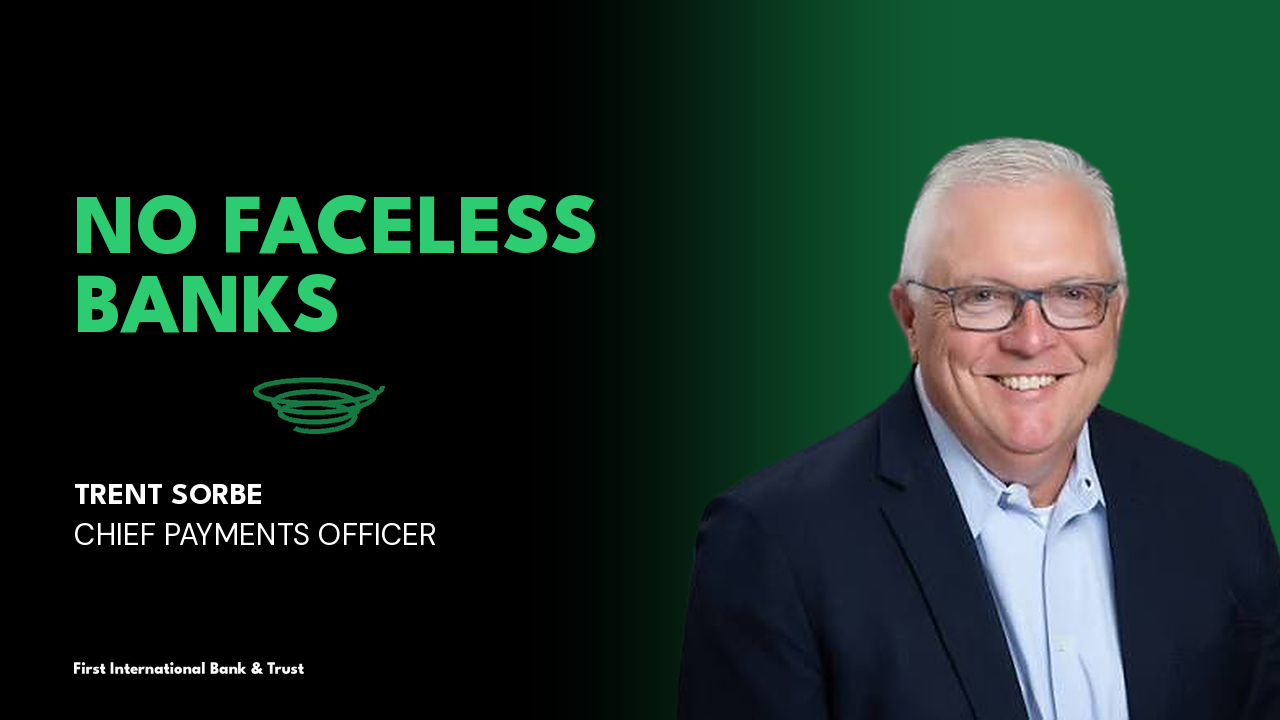
Trent Sorbe joined First International Bank & Trust (FIBT) in 2023 as the institution’s first chief payments officer. He previously held senior positions at four nationwide payment card issuers as well as the FDIC. With more than 30 years of credit, debit and prepaid cards and payments experience, Sorbe is leading the bank’s payment initiatives, including its Kotapay division, a top-50 ACH originator that settled over $124 billion in ACH originations in 2025. In 2026, Trent was elected to the ICBA Payments Board of Directors.